
How Administrative Procedures and Tax Appeals Work in Spain
Receiving an official notification from the Spanish Tax Agency (Agencia Tributaria – AEAT) can be daunting. Administrative tax procedure in Spain is complex—mastering its mechanisms typically requires years of university study. It is completely normal to feel confused or overwhelmed when a formal demand or resolution arrives in your mailbox.
Understanding how administrative procedures function and knowing your legal rights when filing an appeal are key to protecting your interests. Below is a structured breakdown of how the process works and what options you have to challenge AEAT decisions.
Buy The Guide on How to Appeal AEAT
Buy How to Appeal AEAT
What you will find in this Guide (17 pp.):
- Submitting documents in ordinary procedures
- Appeals and claims: types and submission
- Submitting complaints
- Step-by-step guide on how to navigate the AEAT website
Part I: The Structure of an Administrative Procedure
Every formal interaction with the Spanish Tax Administration follows a legally defined life cycle.
1. Initiation (Inicio)
An administrative procedure begins in one of two ways:
- Ex Officio (De oficio): Initiated directly by the Tax Authority, such as a tax verification, data check, or audit procedure (procedimiento de comprobación o inspección).
- At the Request of the Interested Party (A petición del interesado): Initiated by the taxpayer, such as applying for a certificate of tax residence (certificado de residencia fiscal).
2. Allegations (Alegaciones)
Taxpayers have the right to submit allegations, supporting documents, and evidence at any stage of the procedure prior to the formal Hearing Phase (Trámite de Audiencia).
3. The Hearing Phase (Trámite de Audiencia)
Once the file has been instructed and immediately before drafting the proposed resolution, the Administration must open the case file to the taxpayer.
- Timeline: You will be granted a period of no less than 10 days and no more than 15 days to review the complete file, submit final allegations, and present relevant evidence.
- Exceptions: In certain legally specified conditions, this phase may be waived if no third-party rights are affected and no new facts or evidence are introduced.
Submitting Additional Information
If you need to submit additional documents or present allegations during an administrative procedure, you can do so quickly through the Tax Agency’s website.
Where do you find the CSV? The Secure Verification Code (CSV) is a unique 16-character code printed at the bottom of the first page of any official notification or document sent by the Tax Agency.
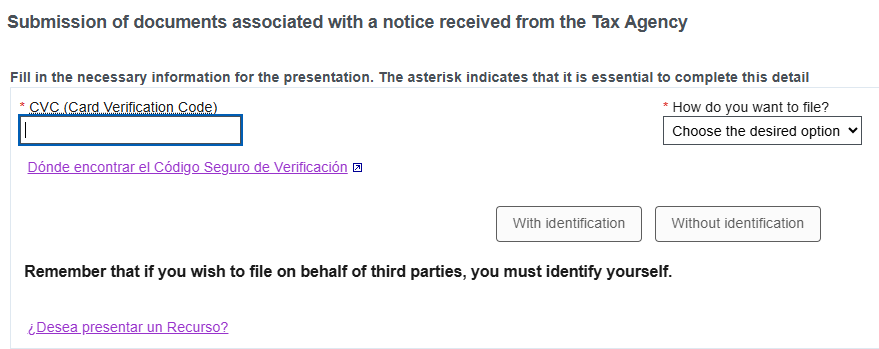
Access the Portal: Switch to English.
Go to the Electronic Register.
Select CSV (Secure Verification Code).
4. Administrative Decisions (Resoluciones Administrative)
The procedure concludes with an official administrative resolution containing the final decision.
- Justification (Motivación): The resolution must be justified with legal and factual reasoning.
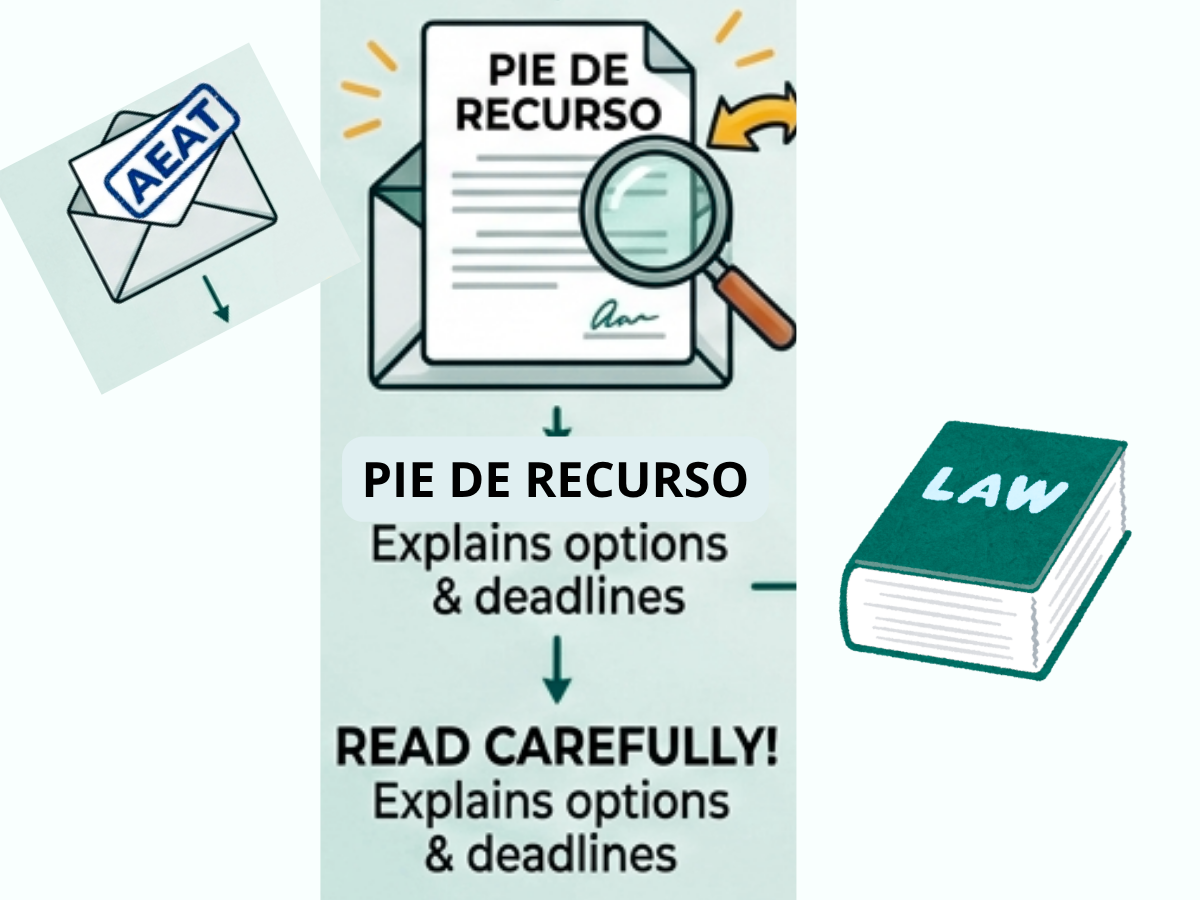
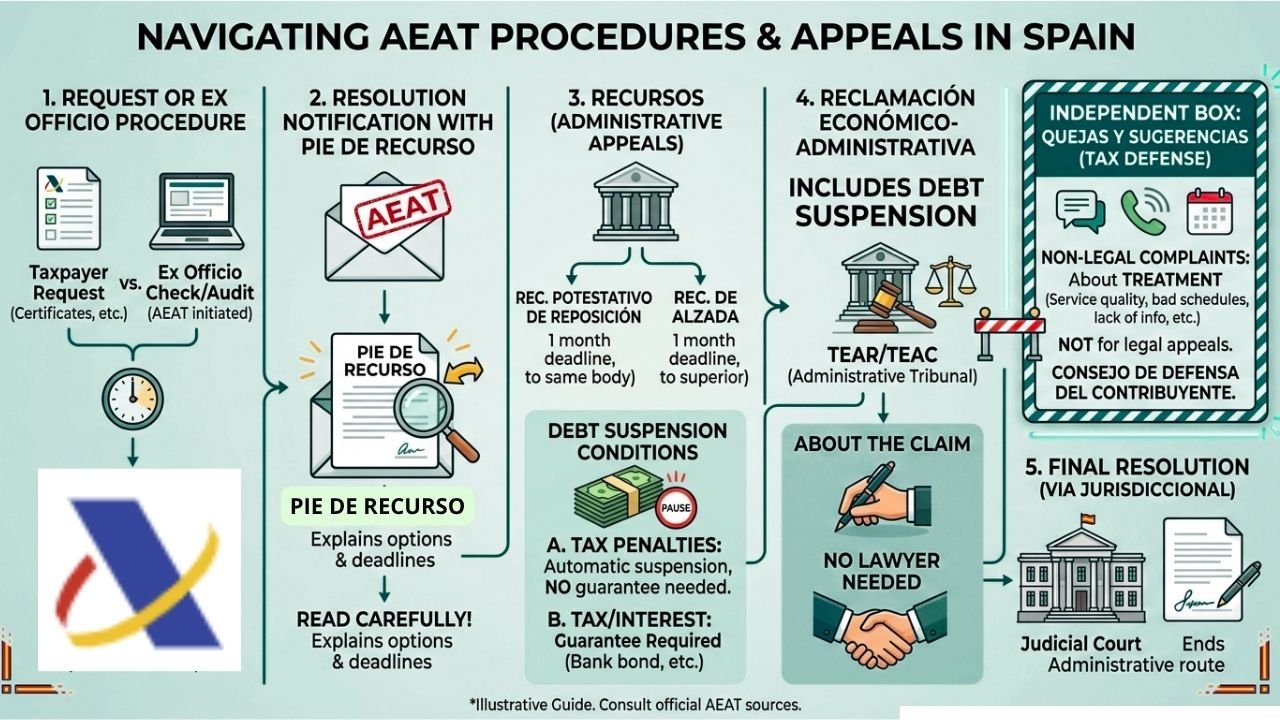
- Appeal Footer (Recursos y Reclamaciones, Pie de Recurso): By law, all final resolutions and qualifying procedural acts must include a mandatory section at the end detailing:
- The exact legal remedies/appeals available against the decision.
- The specific administrative body or court where the appeal must be lodged.
- The strict deadline for filing the appeal.
Part II: Appealing AEAT Decisions (Recursos)
If you disagree with a resolution or an intermediate procedural act that impacts your rights, you have the right to challenge it.
Which Acts Can Be Appealed?
- Final Resolutions: Any decision that provisionally or definitively recognizes or denies a right, or establishes a financial duty or legal obligation.
- Procedural Acts (Actos de trámite): Intermediate actions can only be appealed independently if they directly or indirectly decide the outcome of the case, prevent the continuation of the procedure, cause a lack of defense (indefensión), or lead to irreparable harm to your rights.
(Note: Minor procedural acts cannot be appealed independently; they must be contested when challenging the final resolution.)
The 4 Administrative Routes to Challenge the AEAT
Depending on whether the decision exhausts the administrative route (pone fin a la vía administrativa), you have distinct options:
1. Hierarchical Appeal (Recurso de Alzada)
- When to use: Used against resolutions and procedural acts that do not exhaust the administrative route.
- Where to file: Before the immediate hierarchical superior of the body that issued the decision.
- Deadline: 1 month from the day following notification. Filing this appeal is mandatory before you can take the case to court.
2. Optional Reconsideration Appeal (Recurso Potestativo de Reposición)
- When to use: Challenging administrative acts that end the administrative route, or as an optional initial step before filing an Economic-Administrative Claim.
- Where to file: Before the exact same administrative body that issued the original decision.
- Deadline: 1 month from the day following notification.
3. Extraordinary Review Appeal (Recurso Extraordinario de Revisión)
- When to use: Used only against final decisions where a clear factual error has occurred or where essential new documents surface after the conclusion of the procedure.
4. Economic-Administrative Claims (Reclamaciones Económico-Administrativas)
For tax-specific matters, taxpayers can appeal tax assessments (liquidaciones), explicit or implied denials, and decisions granting or rejecting tax exemptions or benefits through specialized tax boards called Economic-Administrative Tribunals (Tribunales Económico-Administrativos):
- Central Tribunal (TEAC): Handles high-value claims, appeals against central Tax Agency bodies, and second-instance appeals.
- Regional/Local Tribunals (TEAR/TEAL): Handle regional and local claims in the first instance.
Key Feature: Despite being called “tribunals,” these are administrative bodies within the Ministry of Finance (Ministerio de Hacienda), not judicial courts. However, they operate independently. Taxpayers can file claims themselves without hiring a lawyer or court agent (procurador).
Suspension of Debt Execution During Appeals
Filing an appeal does not automatically pause the obligation to pay a tax debt, except under specific conditions:
- Tax Penalties (Sanciones): The collection of a penalty is automatically suspended without requiring any guarantee or bond while an administrative appeal or economic-administrative claim is pending.
- Tax Principal & Interest (Cuota e Intereses): Execution is automatically suspended upon request only if you provide a sufficient guarantee (e.g., a bank guarantee, mortgage, or deposit) covering the principal amount, default interest, and potential surcharge.
Understanding the Appeal Footer (Pie de Recurso) Examples
When you receive an AEAT document, look closely at the footer text to know your immediate choices:
- Example A (Mandatory Administrative Route):
- “Against this administrative act, you may file a Hierarchical Appeal (Recurso de Alzada) before [Higher Body] within one month starting the day after notification…”
- Meaning: You must exhaust this administrative remedy before you are permitted to take the case to judicial court.
- Example B (Optional Administrative Route):
- “Against this notice, you may file, as an optional prior step, a Motion for Reconsideration (Recurso de Reposición) before this Inspection Department, OR alternatively, an Economic-Administrative Claim (Reclamación Económico-Administrativa), within one month…”
- Meaning: You can choose either option. If you opt for the Economic-Administrative route and receive an unfavorable ruling, you can then proceed directly to the judicial courts.
5. Taxpayer Complaints & Rights (Quejas y Sugerencias)
Not every issue with the Spanish Tax Agency stems from a legal disagreement over tax calculations. Often, taxpayers face administrative friction regarding service quality and treatment.
For these non-legal issues, you have the right to file formal Complaints and Suggestions (Quejas y Sugerencias).
What Can You Complain About?
Complaints do not challenge the legal or financial outcome of a tax assessment. Instead, they address issues related to the operation and service quality of the administration, including:
- Lack of clear or understandable information.
- Poor administrative assistance or unhelpful guidance.
- Scheduling conflicts, lack of appointments, or long wait times.
- Delays or improper handling by administrative staff.
The Taxpayer Defense Council (Consejo de Defensa del Contribuyente)
Integrated within the Ministry of Finance (Ministerio de Hacienda), the Taxpayer Defense Council is the specialized body tasked with safeguarding taxpayer rights.
- Role: It monitors the effectiveness of taxpayer rights, evaluates formal complaints regarding how state tax authorities apply the tax system, and formulates binding proposals and recommendations to improve administrative operations.
- Key Distinction: Filing a complaint or suggestion with the Council does not halt or extend any legal deadlines for filing tax appeals (reposición, alzada, or reclamación económico-administrativa). It runs parallel to the legal process solely to report administrative shortcomings and improve service.
Part III: The Judicial Path (La Vía Contencioso-Administrativa)
If all administrative routes (Vía Administrativa) have been exhausted and the Tax Administration maintains its position, the administrative phase is officially closed.
At this stage, you have the right to take the dispute to the judicial courts by filing a Contentious-Administrative Appeal (Recurso Contencioso-Administrativo).
- Jurisdiction: Independent judicial courts (Judges and Magistrates belonging to the Judicial Branch, completely separate from the Ministry of Finance).
- Requirements: Unlike administrative claims, judicial proceedings require legal representation by a licensed lawyer (Abogado) and court attorney (Procurador).
- Deadline: Generally 2 months from the day following notification of the administrative decision that exhausts the administrative route or rejects your Economic-Administrative Claim.
Basic Glossary
| Término en Español | English Translation |
| Recurso y reclamaciones | Appeals and claims / disputes |
| Pie de recurso | Legal notice on rights of appeal / Notice of available remedies |
| Recurso de alzada | Hierarchical appeal (to a superior authority) |
| Recurso de reposición | Motion for reconsideration (filed with the same authority) |
| Reclamación económico-administrativa | Economic-administrative claim / Tax dispute claim |
| Tribunal económico-administrativo | Economic-Administrative Tribunal / Tax Appeals Board |
| Recurso Contencioso-Administrativo | Judicial appeal / Contentious-administrative appeal |
| Juzgado contencioso-administrativo | Contentious-Administrative Court / Administrative Court |
| Consejo de Defensa del Contribuyente | Taxpayer Council |
For an step-by-step guide on how to navigate the AEAT to submitting documents, appeals, claims and complaints, download our PDF.
Expat Tax Guides Library
Moving abroad shouldn’t mean overpaying on your taxes. Master the complexities of expat filing with our comprehensive, easy-to-follow resources.
Explore the Expat Tax Guides Library
Get Your Guide: How to Appeal/Submit Documents to AEAT
Submitting Documents to AEAT
What you will find in this Guide:
- Submitting documents in ordinary procedures
- Appeals and claims: types and submission
- Submitting complaints
- Step-by-step guide on how to navigate the AEAT website