
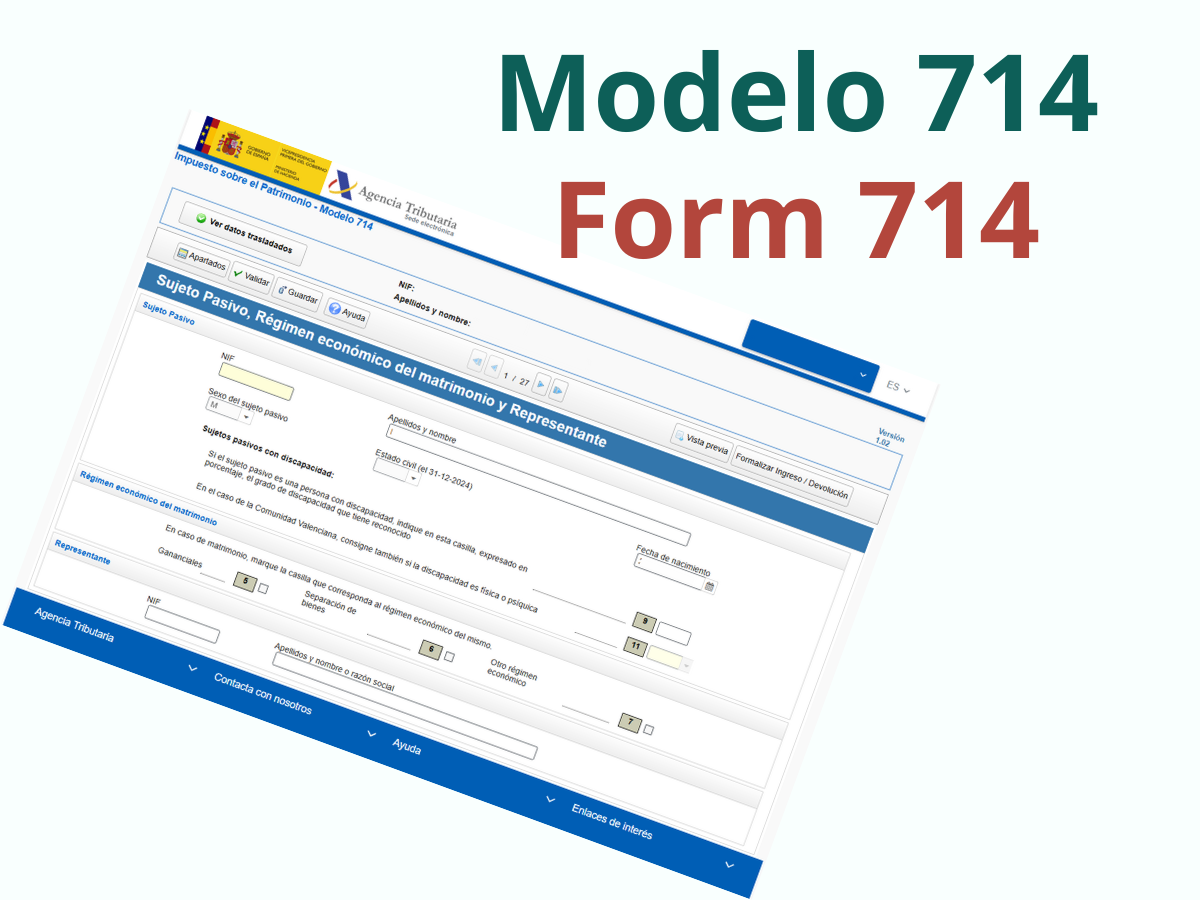
💰 Spain’s Net Wealth Tax (Impuesto sobre el Patrimonio) Explained
Understanding the Spanish Net Wealth Tax (Impuesto sobre el Patrimonio) is a crucial aspect of financial planning for anyone with significant assets in Spain or globally if they become a tax resident.
🏛️ Administration and Regional Power
The Wealth Tax is a state-level tax, but its management and collection are highly decentralized:
- Management: 100% of the revenue from the Wealth Tax is transferred to the Autonomous Communities (Spain’s regional governments).
- Regional Power: The Autonomous Communities hold the authority to set their own rules for the minimum tax exemption (mínimo exento), the applicable tax rates (tipos impositivos), and any bonuses or deductions.
- State Default: Should a Community choose not to establish its own rules, the general state rules apply by default.
Q1: Filing Requirement: The Minimum Exemption
An individual is obligated to file a Wealth Tax return if their gross assets (total value of assets before deducting debts) are valued at more than the minimum tax-exempt amount (mínimo exento).
- General State Minimum: Where the regional government has not set a specific amount, the minimum exemption is €700,000.
- The €2 Million Rule: Even if your net wealth is below €700k, you must still file if your gross assets (ignoring debts and the home bonus) exceed €2,000,000.
- Taxable Wealth: The tax is applied only to the portion of your net worth (assets minus debts and the minimum exemption) that exceeds this threshold.
- Primary Residence Exemption: Your primary residence is exempt up to a maximum of €300,000. This exemption is in addition to the minimum exempt amount.
The key difference is this:
| €700,000 Rule | €2,000,000 Rule | |
|---|---|---|
| What you measure | Net wealth (assets minus debts) | Gross assets (ignoring debts) |
| Do you deduct your mortgage? | ✅ Yes | ❌ No |
| Do you apply the €300k home bonus? | ✅ Yes (for residents) | ❌ No |
| When does this rule trigger filing? | When your net wealth exceeds €700k | When your gross assets exceed €2M, even if your net wealth is below €700k |
Q2: Mínimo Exento in Key Autonomous Communities
The table below highlights the minimum exemption thresholds set by various Autonomous Communities.
| Autonomous Community | Minimum Exemption (€) | Notes on Disability & Bonuses |
| State Default | 700,000 | Applies where Community hasn’t regulated |
| Andalusia | 700,000 | 100% Bonus in effect (0 tax due) |
| Aragón | 700,000 | |
| Balearic Islands | 3,000,000 | |
| Canary Islands | 700,000 | |
| Catalonia | 500,000 | |
| Extremadura | 500,000 | Higher exemption for registered disabilities |
| Murcia | 700,000 | |
| Valencia | 1,000,000 |
Do you need to file Wealth Tax 2025?
📥 Download the Free 5-Minute Spanish Wealth Tax Assessment here:
In this video, we break down the official rules for the 2025 tax season (filing by June 30, 2026) so you can protect your assets and stay compliant.
👤 Scope: Residents vs. Non-Residents
The obligation to declare the tax depends on your tax residency status in Spain on the day the tax is calculated.
- Tax Obligation for Residents (Obligación Personal)If you are a tax resident in Spain, you must declare your total worldwide assets (all assets and rights, regardless of their global location) as they stand on December 31st.
- Tax Obligation for Non-Residents (Obligación Real)If you are not a tax resident in Spain, your obligation is limited to declaring only the assets and rights located, exercisable, or required to be fulfilled within Spanish territory. This includes real estate located in Spain, bank accounts held in Spanish banks, or assets linked to a professional activity carried out here.
Expat Tax Guides Library
Moving abroad shouldn’t mean overpaying on your taxes. Master the complexities of expat filing with our comprehensive, easy-to-follow resources.
Explore the Expat Tax Guides Library
Persons Required to File
Taxpayers, whether subject by personal obligation or by real obligation to contribute, are required to submit a tax return if:
- Their tax liability—determined in accordance with the regulatory rules of the Tax and after applying any applicable deductions or allowances—results in a payment due.
- Alternatively, even if no payment is due, when the value of their assets or rights—determined in accordance with the regulatory rules of the Tax—exceeds 2,000,000 euros.
Note: In the context of Spanish tax law, “Personal Obligation” generally refers to residents taxed on their worldwide assets, while “Real Obligation” refers to non-residents taxed only on assets located within Spanish territory.
🗓️ Calculation Date: The tax liability is always determined based on the value of your wealth as it exists on December 31st of the tax year.
⚖️ Valuing Assets and Deducting Debts
The calculation of your Gross Wealth requires specific valuation rules for different asset classes:
Asset Valuation Rules (Valoración de Bienes)
| Asset Type | Valuation Rule |
| Real Estate (Property) | The highest of these three values: Catastral Value, value set/checked by the tax authority, or Acquisition Price/Value. |
| Bank Deposits (Accounts) | The highest of the balance on December 31st or the average balance of the last quarter of the year. |
| Public Debt/Traded Securities | The average trading price of the fourth quarter of the year. |
| Life Insurance | The surrender value (the cash-out value) on December 31st. |
| Virtual Currencies (Cryptocurrency) | Their value in euros on December 31st. |
| Other Assets | Luxury vehicles, art, jewelry, etc., are valued at their market value on December 31st. |
Deductions for Debts and Charges
You are permitted to deduct debts and personal obligations that you are liable for, as well as real charges and encumbrances (such as mortgages) that reduce the value of specific assets.
📊 Tax Rates and Progressive Scales
The tax is applied to the Net Taxable Base (Gross Assets – Deductible Debts – Minimum Exemption) using a progressive scale, meaning the tax rate increases as the net wealth amount rises.
Tax Scales: State, Andalusia, and Valencia (Example Rates)
The following partial table shows how regional governments can set their own progressive scales.
| Taxable Base (€) | State Rate (%) | Andalusia Rate (%) | Valencia Rate (%) |
| Up to 167,129.45 | 0.20% | 0.20% | 0.25% |
| From 167,129.45 to 334,252.88 | 0.30% | 0.30% | 0.37% |
| From 334,252.88 to 668,499.75 | 0.50% | 0.50% | 0.62% |
| Over 10,695,996.06 | 3.50% | 3.50% | 3.50% |
🎁 Important Note on Bonuses: Some Autonomous Communities, most notably Andalusia, have implemented a 100% bonus on the tax quota. This means that although residents must file the return, the amount payable is zero.
The “60% Rule” (The Fiscal Shield)
Pro Tip: This is the “Aha!” moment for retirees. Spain has a “Tax Shield” to prevent taxation from being “confiscatory.”
The total of Wealth Tax + Income Tax cannot exceed 60% of your taxable income base.
Example: If you are a retiree with high assets but a small pension of €30,000. Your combined tax bill cannot exceed €18,000 (60% of €30,000).
And here’s breaking news for expats: The Supreme Court just ruled that non-residents get this same protection. If you paid Wealth Tax in 2023-2025 as a non-resident, you may be due a refund.
💡 Calculation Example: Determining Final Tax Due
The calculation uses the Net Taxable Base but incorporates the value of certain exempt assets (like the primary residence exemption) into the process to determine the applicable average tax rate (progressivity).
| Data (Hypothetical) | Value (€) |
| A: Net Taxable Base (After debts and minimum exemption) | 356,900 |
| B: Exempt Assets (Used for rate calculation only, e.g., primary home) | 68,000 |
- Determine the Base for Rate Calculation: Sum the Net Taxable Base (A) and Exempt Assets (B):
- 356,900 + 68,000 = 424,900
- Apply the Tax Scale (State Example):
- Tax on first €334,252.88: €835.63
- Remaining base (€90,647.12) taxed at 0.50%: 90,647.12 * 0.0050 = €453.24
- Total Tax Resulting: €835.63 + €453.24 = €1,288.87
- Calculate the Average Tax Rate (TMG): Divide the Total Tax Resulting by the Rate Calculation Base:
- TMG = (1,288.87 / 424,900) * 100 = 0.3033%
- Calculate the Total Tax Due (Cuota Íntegra): Apply the final average rate only to the Net Taxable Base:
- Cuota Íntegra = 356,900 * 0.003033 = €1,082.26
Looking for the Complete 2026 Tax Kit? Don’t waste time searching the BOE. We have curated essential AEAT forms—including the one on this page—into a single, high-resolution download kit for expats.
The Spanish Wealth Tax (Impuesto sobre el Patrimonio) operates differently for non-residents than for tax residents. Non-residents are taxed under the “Real Obligation” rule, meaning they are only assessed on assets situated in Spanish territory.
Tax Guide 2026
If you need an overall view of tax obligations, click on Taxes in Spain Guide 2026.