Inheritance & Gift Tax (Impuesto sobre Sucesiones y Donaciones – ISD) for Spanish Residents
The Inheritance and Gift Tax (ISD) is a tax levied in Spain on the recipient of assets (the heir or donee), not on the estate of the deceased or the donor. While the core framework is national, significant taxing power is devolved to the Autonomous Communities (CC. AA.).
For Spanish tax residents, this tax applies under the Personal Obligation rule, meaning it covers worldwide assets and rights received, regardless of where they are physically located.
🏛️ Core Principles of the ISD
Key Taxable Events
The ISD is triggered by three main events:
- Inheritance (Mortis Causa): Acquisition of assets or rights upon the death of the transferor.
- Gifts (Inter Vivos): Gratuitous transfer of assets or rights between living persons (donations).
- Life Insurance: Receipt of amounts by beneficiaries when the policyholder is someone other than the beneficiary.
Obligation to Pay
The tax liability falls upon the individual receiving the transfer:
- In Inheritances: The heirs or legatees.
- In Gifts: The donee (the person receiving the gift).
- In Life Insurance: The designated beneficiaries.
Tax Base Calculation
The tax is applied to the Net Value of the acquisition:
- For Inheritances/Gifts: The gross value of assets/rights acquired minus any deductible charges and debts (e.g., funeral costs, outstanding mortgages).
- For Life Insurance: The amounts received are taxed, often accumulated with other inherited assets if the deceased was the policyholder.
🗺️ Jurisdiction and Applicable Law
For individuals who are Spanish tax residents, the jurisdiction for processing the tax and applying the regional rules is typically transferred to the Autonomous Community where the deceased/donor was habitually resident (for inheritances) or where the recipient is resident (for gifts).
| Recipient/Heir Status | Deceased/Donor Status | Tax Obligation | Applicable Law | Assets Taxed |
| Spanish Resident | Spanish Resident | Personal | CC. AA. of deceased/donor’s residence | Worldwide |
| Spanish Resident | Non-Resident | Personal | CC. AA. of recipient’s residence (with options) | Worldwide |
💸 Tax Burden: National vs. Regional Law
The biggest planning variable in the ISD is the difference between the State (National) Law and the regional CC. AA. Laws.
The National (State) Law
If the Autonomous Community has not approved its own specific rules, or if those rules cannot be applied, the State Law is used. This system uses a highly progressive tax rate scale, which is then dramatically adjusted by a multiplier.
A. Progressive Tax Rate (Cuota Íntegra)
The National Taxable Base is subject to a progressive scale starting at $7.65\%$ and reaching up to $34.00\%$.
| Taxable Base (Up to €) | Cumulative Tax (€) | Applicable Rate (%) |
| 7,993.46 | 0.00 | 7.65 |
| 15,980.91 | 611.50 | 8.50 |
| … | … | … |
| Over 797,555.08 | 199,291.40 | 34.00 |
B. The Multiplier Coefficient (Cuota Tributaria)
The resulting tax is multiplied by a coefficient based on two factors: the degree of kinship between the deceased/donor and the recipient, and the recipient’s pre-existing net wealth (Patrimonio Preexistente).
| Pre-Existing Wealth (€) | Group I & II | Group III | Group IV |
| €0 to €402,678.11 | 1.0000 | 1.5882 | 2.0000 |
| Above €4,020,770.98 | 1.2000 | 1.9059 | 2.4000 |
Kinship Groups: Groups I & II (Spouses, children, parents) have the lowest multipliers. Groups III & IV (siblings, non-relatives) face very high multipliers, potentially doubling the final tax due.
The Regional Reliefs (The Planning Opportunity)
Many Autonomous Communities offer significant tax reliefs, reductions, and generous exemptions for close family members (Groups I and II).
- Near-Total Relief: Regions like Madrid, Andalusia, Murcia, and the Canary Islands offer near-total reductions (e.g., 99% or 100% tax bonifications) on the tax quota for inheritances and often for gifts between spouses, parents, and children.
- Generous Exemptions: Some regions offer personal tax-free allowances that far exceed the State’s allowance of €15,957 for Groups I & II (e.g., Andalusia’s mínimo exento often reaches €1,000,000).
For Spanish residents, ensuring the application of a beneficial Autonomous Community’s law (which is possible through correct tax residency declaration and jurisdictional rules) is paramount for minimizing the tax burden on inheritances and gifts.
Tax Guide 2026
If you need an overall view of tax obligations, click on Taxes in Spain Guide 2026.
Summary of Inheritance Tax Regulations by Region (2025)
| Autonomous Community | Group 1 (Descendants < 21) | Group 2 (Spouses, Ascendants, Descendants ≥ 21) | Other Key Details / Groups |
| Andalusia | Reduction up to €1 million. | Reduction up to €1 million. | €250,000 reduction for 2nd/3rd degree relatives. |
| Aragon | 99% bonus on the tax quota. | 99% bonus on the tax quota (extended from previous limits). | Previously limited benefits for minors and inheritances under €500k. |
| Asturias | Exempt up to €300,000. | Exempt up to €300,000. | Exemption applies to spouses, ascendants, and adopters. |
| Balearic Islands | Exempt from tax. | Exempt from tax (ascendants, descendants, spouses). | 25% discount for siblings, uncles/aunts, and nephews/nieces (50% if the deceased had no descendants). |
| Canary Islands | 99.9% discount on the tax quota. | 99.9% discount on the tax quota (extended to siblings, nephews/nieces, and uncles/aunts since Sept 2023). | 99.9% discount on donations between spouses, ascendants, and descendants. |
| Cantabria | 95% bonus on the taxable base of the primary residence (limit €125,000/heir). | 95% bonus on the taxable base of the primary residence (limit €125,000/heir). | Applies to children, parents, and spouses. |
| Castilla-La Mancha | 100% bonus if the inheritance is up to €300,000. | 100% bonus if the inheritance is up to €300,000. | 80% discount if the inheritance exceeds €300,000. |
| Castilla y León | 99% bonus on the tax quota. | 99% bonus on the tax quota. | Applies to direct family members (spouse, descendant, ascendant). |
| Catalonia | Reduction: €100,000 + €12,000/year under 21 (max €196,000). | Spouse/Partner: €100,000 reduction. Parents/Grandparents: €50,000/€30,000 reduction. | Progressive rate based on parentesco. |
| Ceuta & Melilla | 50% bonus on the tax quota (mortis causa). | 50% bonus on the tax quota (mortis causa). | 99% bonus for certain degrees of kinship possible. Regulated by state law with local rules. |
| Valencian Community | 99% discount on the tax quota (retroactive from May 2023). | 99% discount on the tax quota (retroactive from May 2023). | Applies to spouses, ascendants, and descendants for both inheritances and donations. |
| Extremadura | 99% bonus on the adjusted tax quota. | 99% bonus for taxable base up to €175,000. | Tiered bonus for Group 2: 95% up to €325k; 90% up to €600k. From 2025, up to 99% for certain close relatives (e.g., nephews/nieces). |
| Galicia | Reduction of €400,000. | Reduction of €400,000. | Rates from 5% to 18%. €300,000 reduction for disabled persons (Groups 3 & 4). |
| La Rioja | 99% bonus on the tax quota (since 2024). | 99% bonus on the tax quota (since 2024). | Eliminates tax payment for inheritances exceeding €400,000 between direct relatives. |
| Madrid | 99% bonus on the tax quota (since 2017). | 99% bonus on the tax quota (since 2017). | Implies paying only 1% of the tax. Bonus for siblings/uncles/nephews is projected to increase to 50% in 2025. |
| Murcia | 99% bonus on the donation tax rate. | 99% bonus on the donation tax rate. | Applies to families in Group 1, 2, and 3 for donations. |
| Navarre | Rates from 2% to 16%. | Spouses: 0% for under €250,000; 0.8% above. Ascendants/Descendants: 2% to 16%. | Foral Territory (Foral Law applies). |
| Basque Country | Exempt for amounts below €400,000. | Exempt for amounts below €400,000. | Tax rate of 1.5% for amounts above €400,000 (applies to descendants, ascendants, spouses, and domestic partners). |
Self-Assessment Form
You must submit a different Self-Assessment Form depending on the transaction:
| Transaction Type | Form | Description |
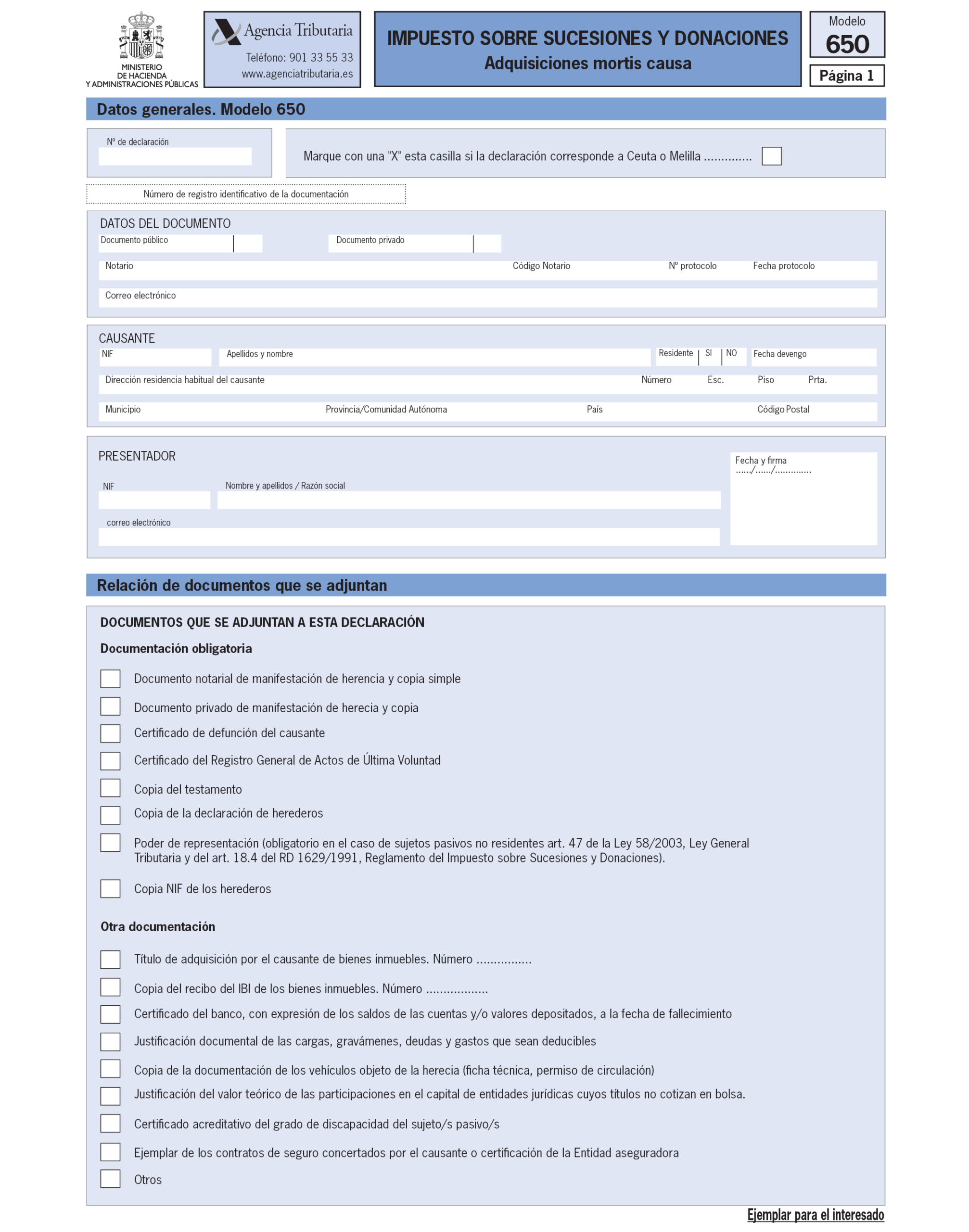
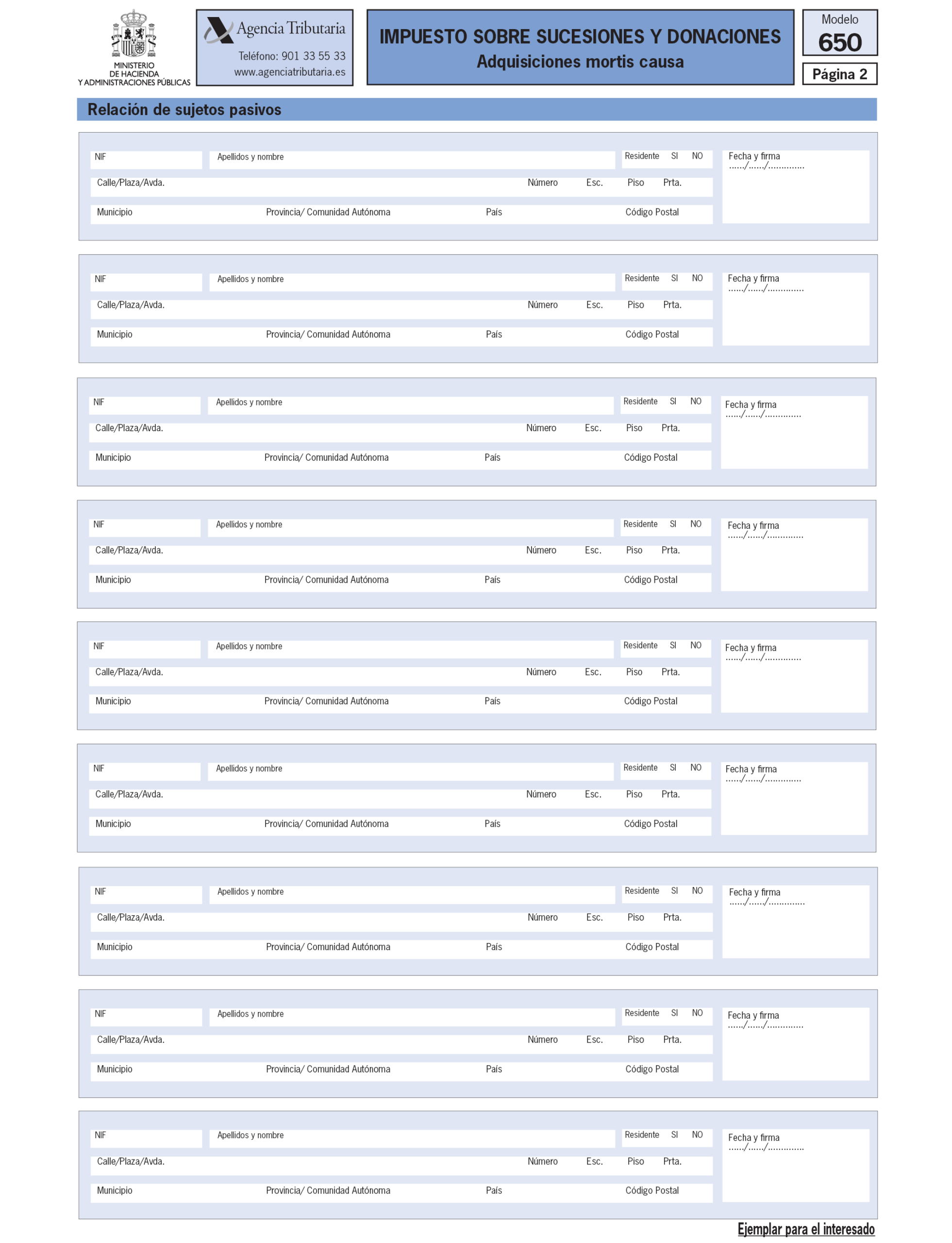
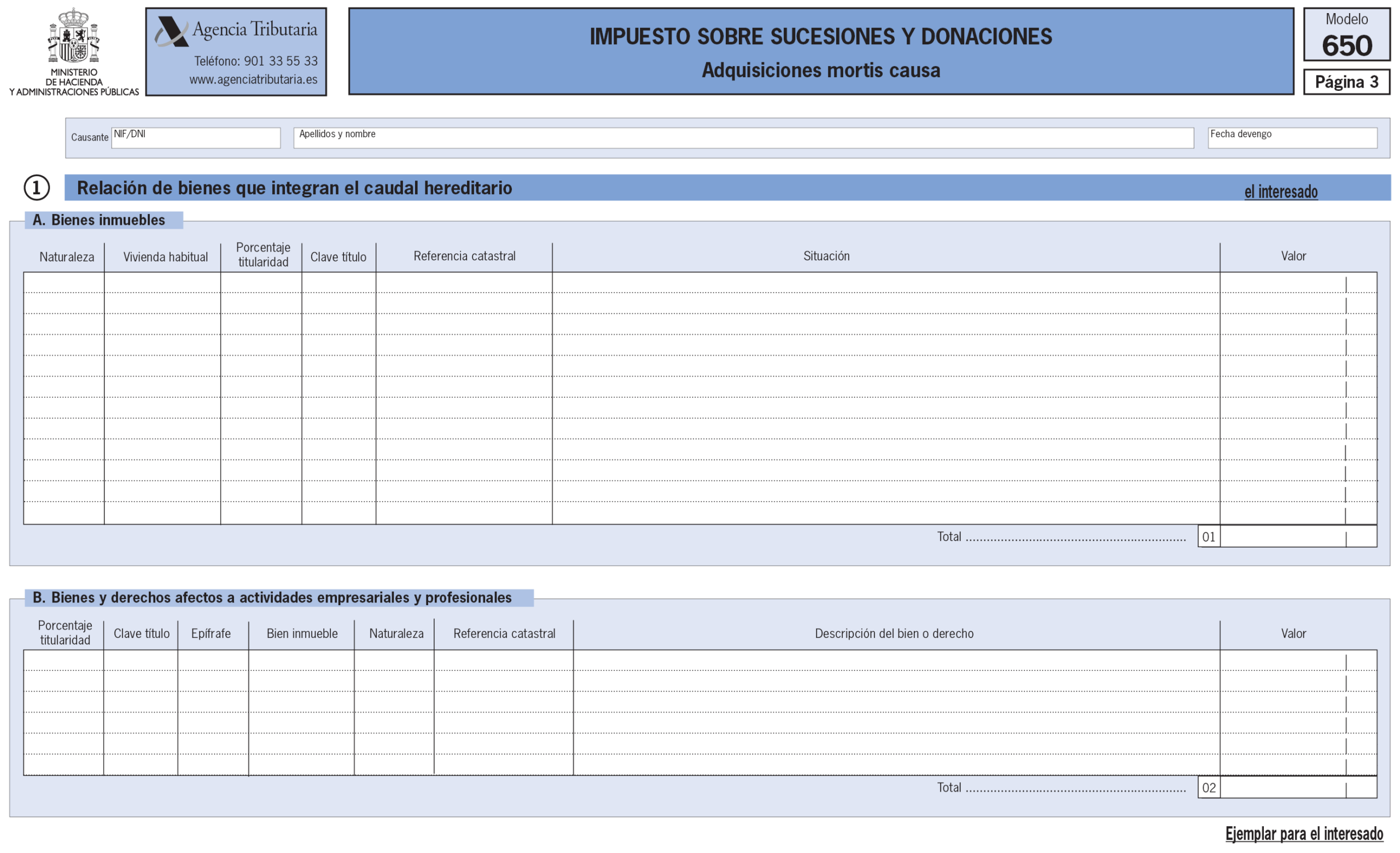
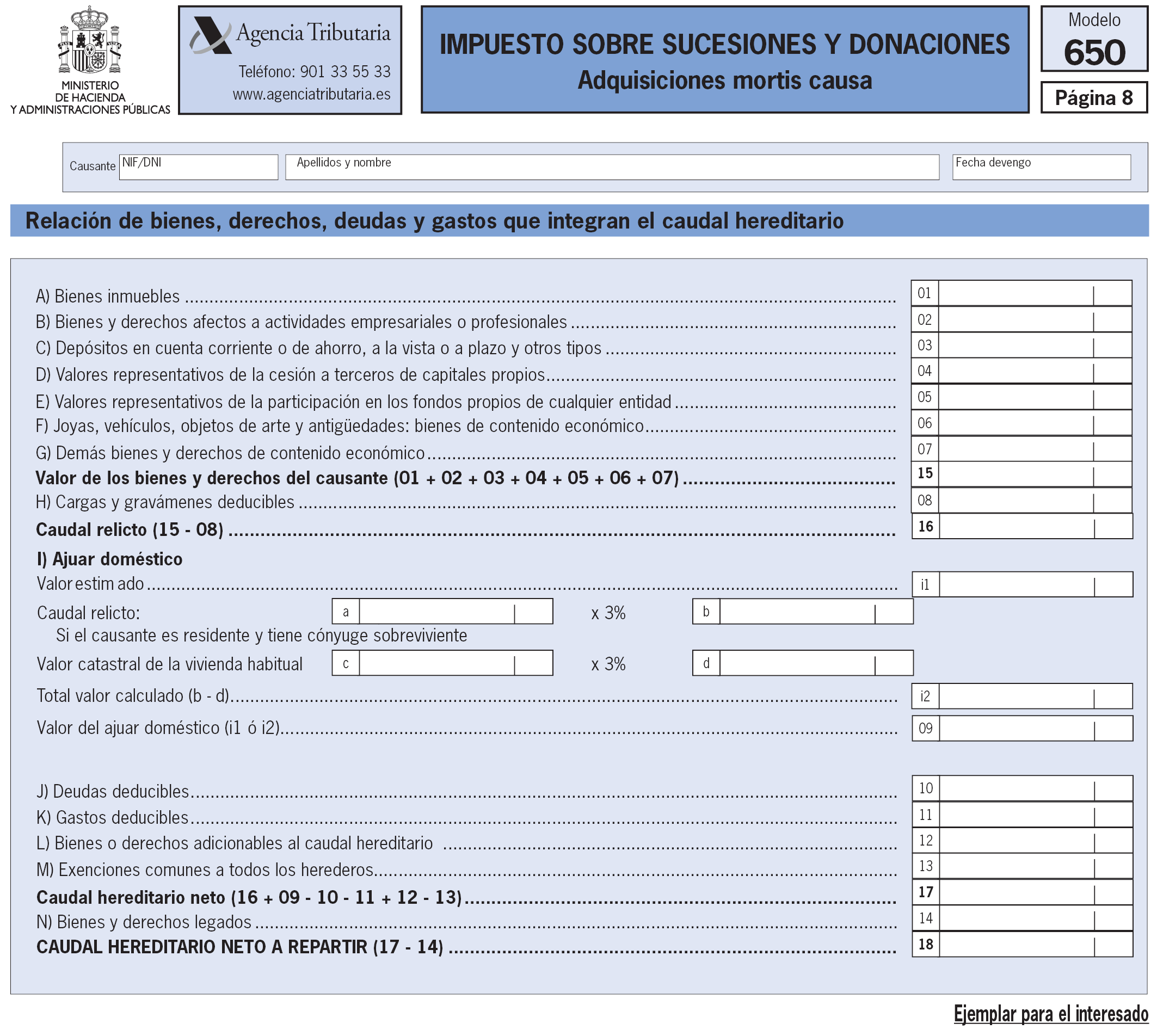
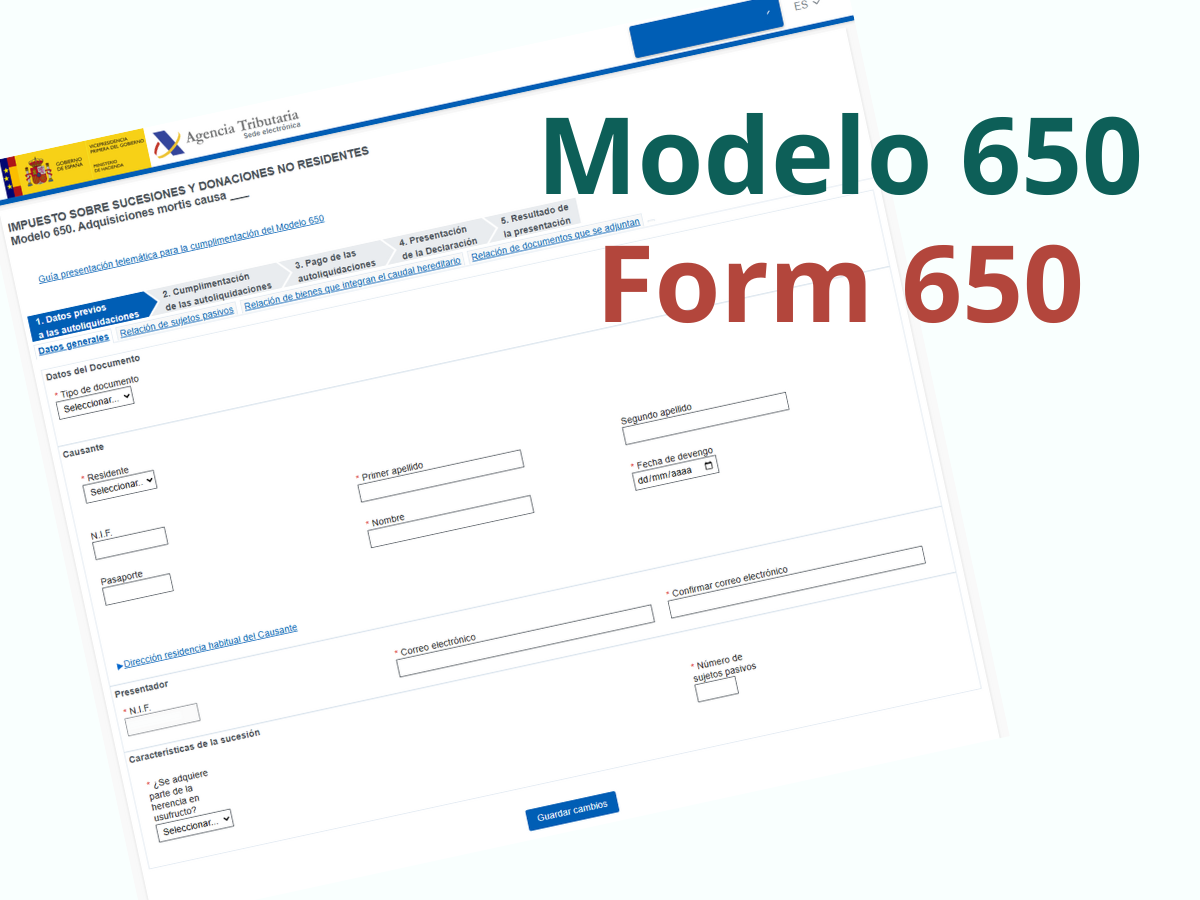
| Acquisitions Due to Death (Succession) | Form 650 | Acquisition of assets and rights by inheritance, bequest, or life insurance proceeds (when the policyholder is different from the beneficiary). |
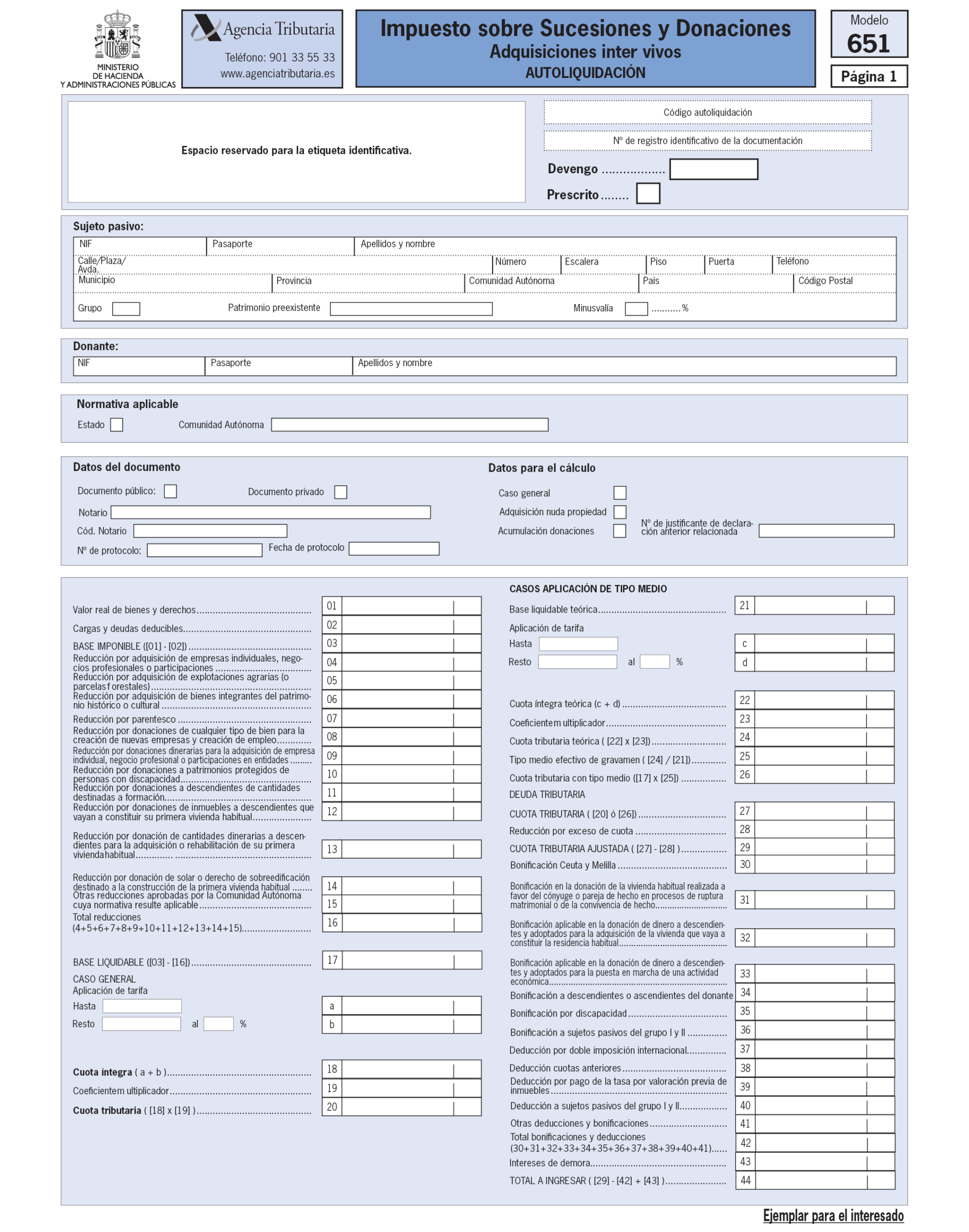
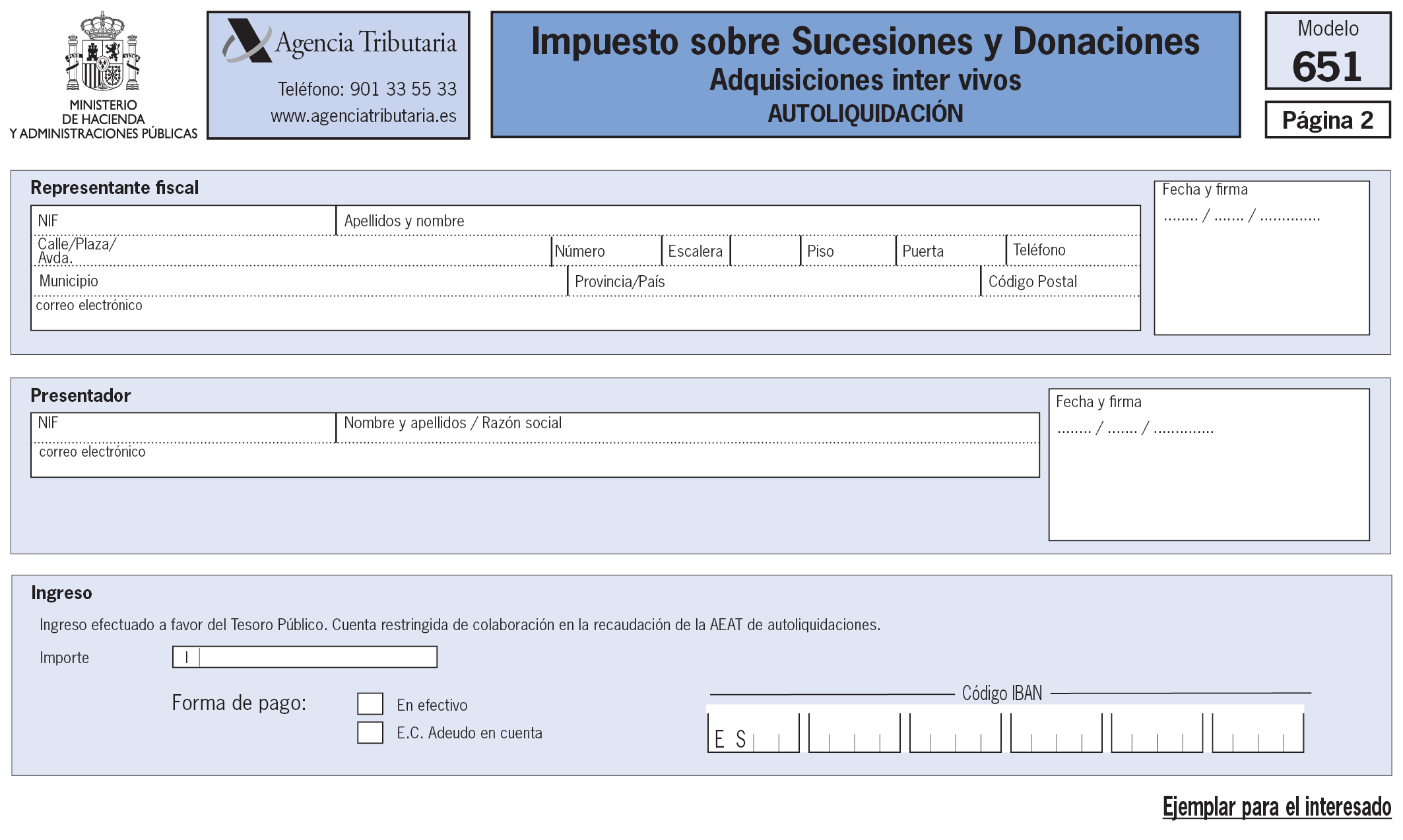
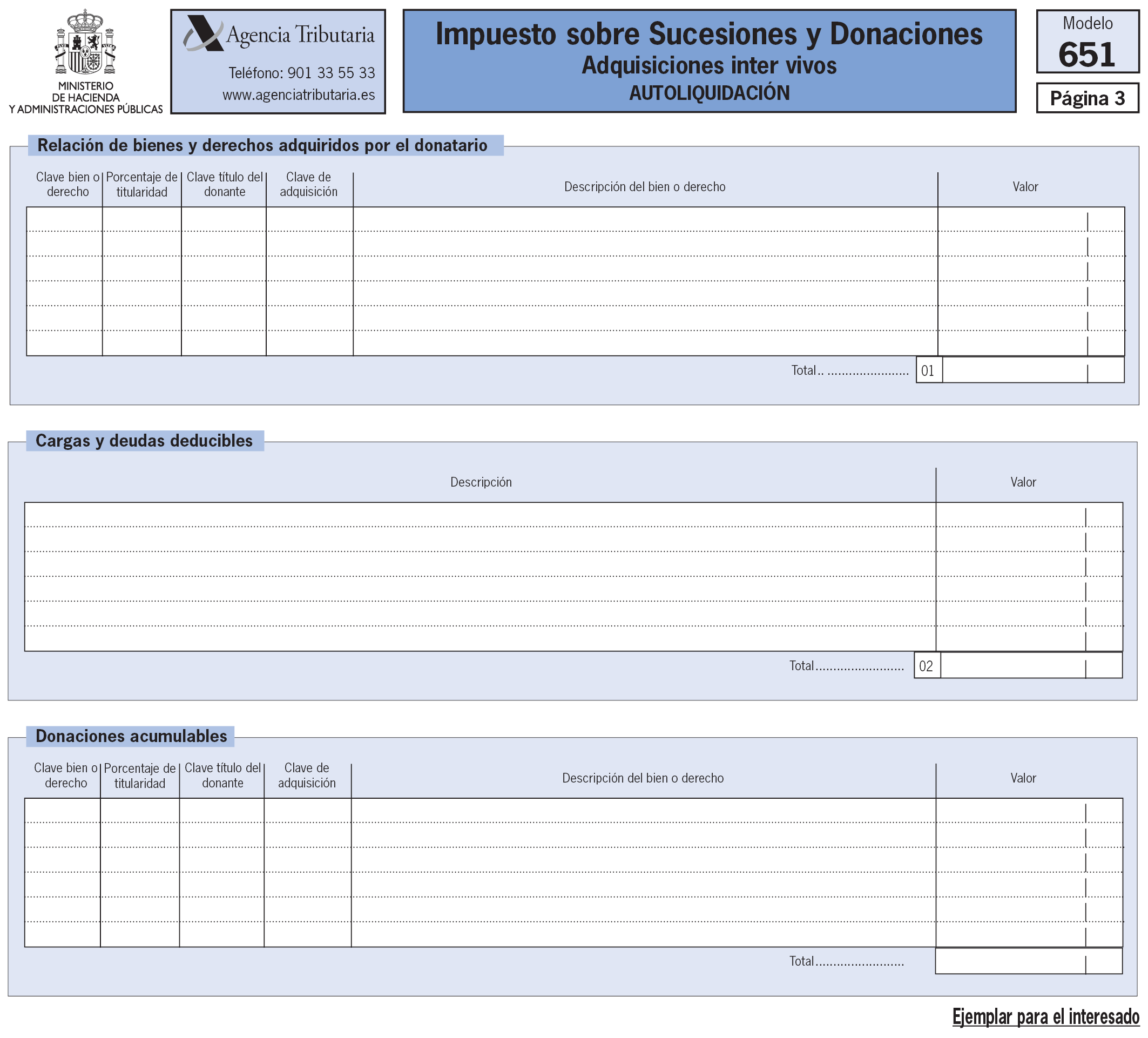
| “Inter Vivos” Acquisitions (Donation) | Form 651 | Acquisition of assets and rights by donation or any other gratuitous legal transaction inter vivos. |
| Extinction of Usufruct | Form 655 | For the extinction of a usufruct. |
📄 Need an official form? > You can download the reference PDF and other tax models in our Spanish Tax Forms Library. We provide summaries and official BOE templates to help you prepare your filing.
🌍 Deduction for International Double Taxation
For Spanish residents who are subject to Personal Obligation (taxed on worldwide assets), receiving assets located in another country that levies a similar inheritance tax can lead to double taxation.
The Spanish tax law provides a deduction to mitigate this:
- Deduction: The Spanish tax due is reduced by the lesser of: (1) the tax effectively paid abroad on that asset, OR (2) the result of applying the Spanish effective tax rate to the net asset value situated outside Spain.
This deduction ensures Spanish residents are not penalized for inheriting worldwide assets but are often still required to go through the administrative process to prove the tax paid abroad.