📝 How to Get Your Spanish Tax Residence Certificate (Modelo 149)
If you’re a new expat in Spain, you’ve likely heard of the Beckham Law, which offers significant tax advantages. The key to unlocking this regime is filing Modelo 149—the official communication to the Spanish Tax Agency (AEAT) that you opt to be taxed under this special regime.
This isn’t just a random piece of paperwork; it’s your formal request to be treated as a tax non-resident (for Spanish-sourced employment income) for up to six years, even though you are physically residing in Spain.
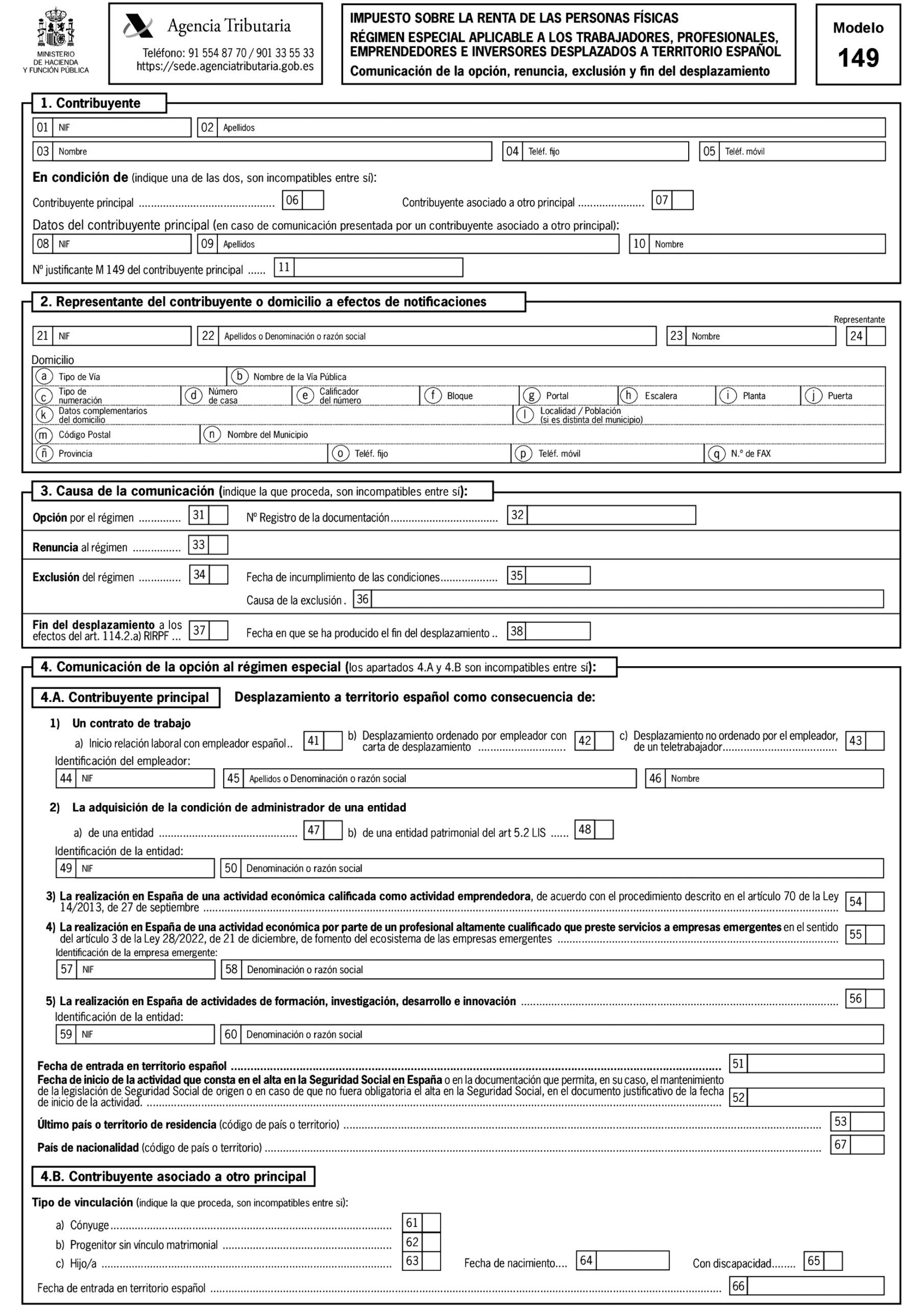
Form 149. IRPF. Special Regime for Workers, Professionals, Entrepreneurs, and Investors Moving to Spanish Territory. Communication of the Option, Renunciation, Exclusion, and End of the Move.
🔑 What is Modelo 149 For?
Modelo 149 is the application form for the Special Tax Regime Applicable to Workers, Professionals, Entrepreneurs, and Investors who Move to Spanish Territory (the official name for the Beckham Law).
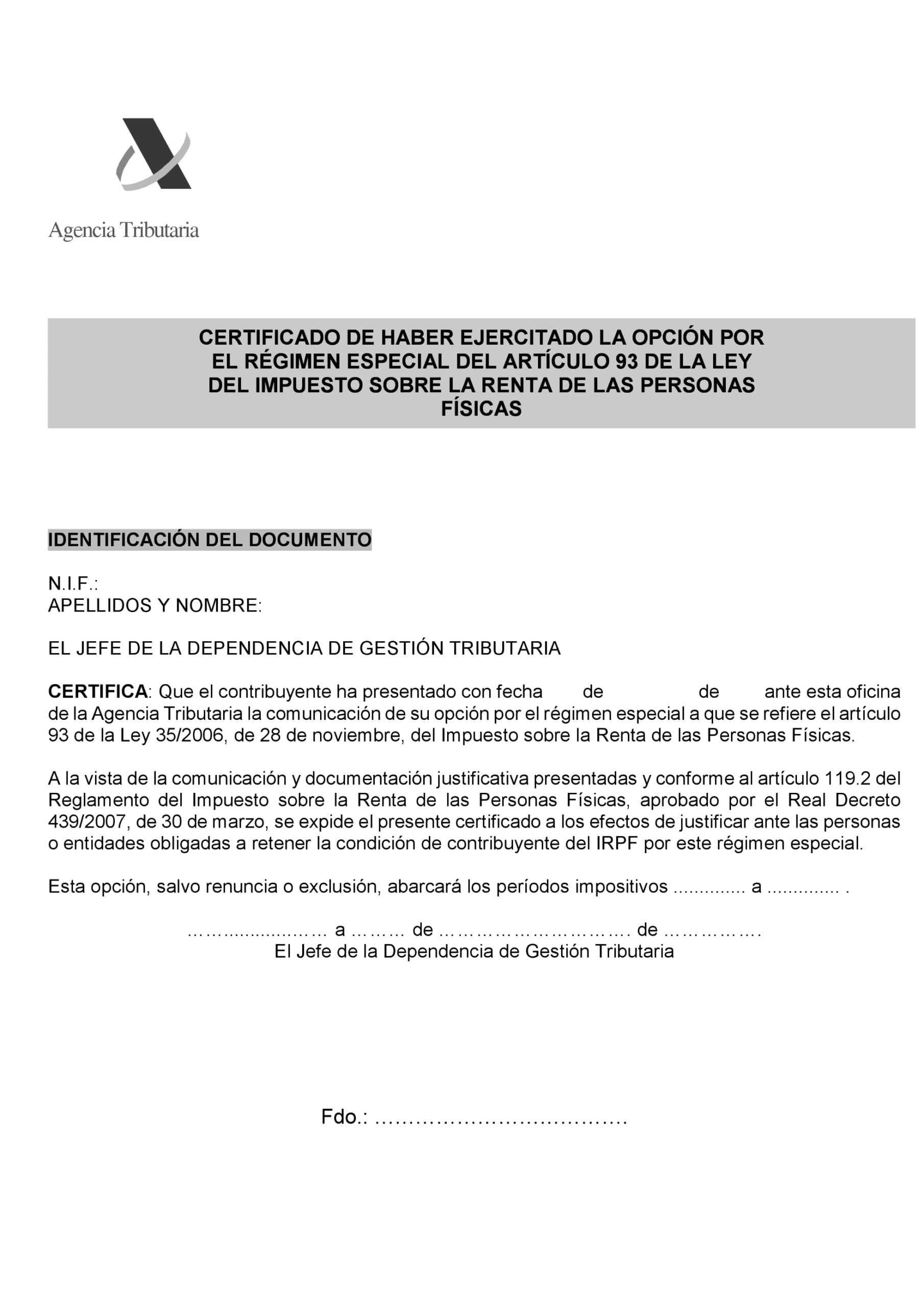
Upon approval, the AEAT grants you a certificate confirming your acceptance into the regime.
✅ Key Eligibility Requirements
Before filing, ensure you meet the main criteria (these have been updated in recent years):
- Prior Residency: You must not have been a Spanish tax resident in the five tax years immediately prior to the year you move to Spain.
- Reason for Move: Your relocation to Spain must be due to:
- An employment contract (with a Spanish company or remote work for a non-Spanish company).
- Acquisition of a director position (with limits on company share ownership).
- Carrying out entrepreneurial activity or being a highly qualified professional (e.g., providing R&D services to an emerging company).
- Deadline: You must submit Modelo 149 within six months of your registration with the Spanish Social Security system in Spain (or the date of documentation enabling the maintenance of non-Spanish social security legislation, such as an A1 certificate). Missing this deadline means missing the regime entirely.
💡 Tip: When searching the AEAT website, using the exact phrase “Régimen especial de impatriados” or the form number “Modelo 149” will yield the most accurate results.
Modelo 149 Online and Paper
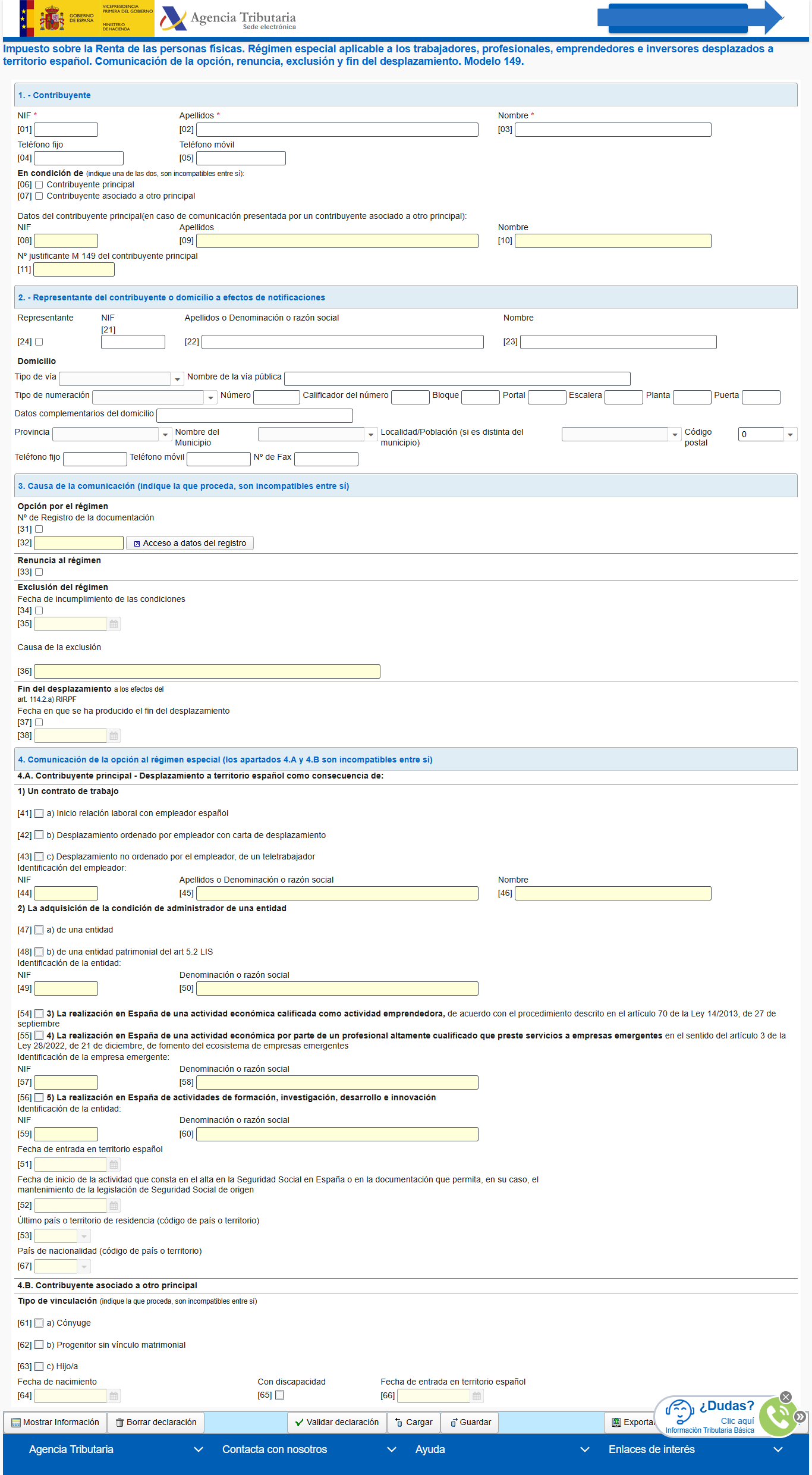
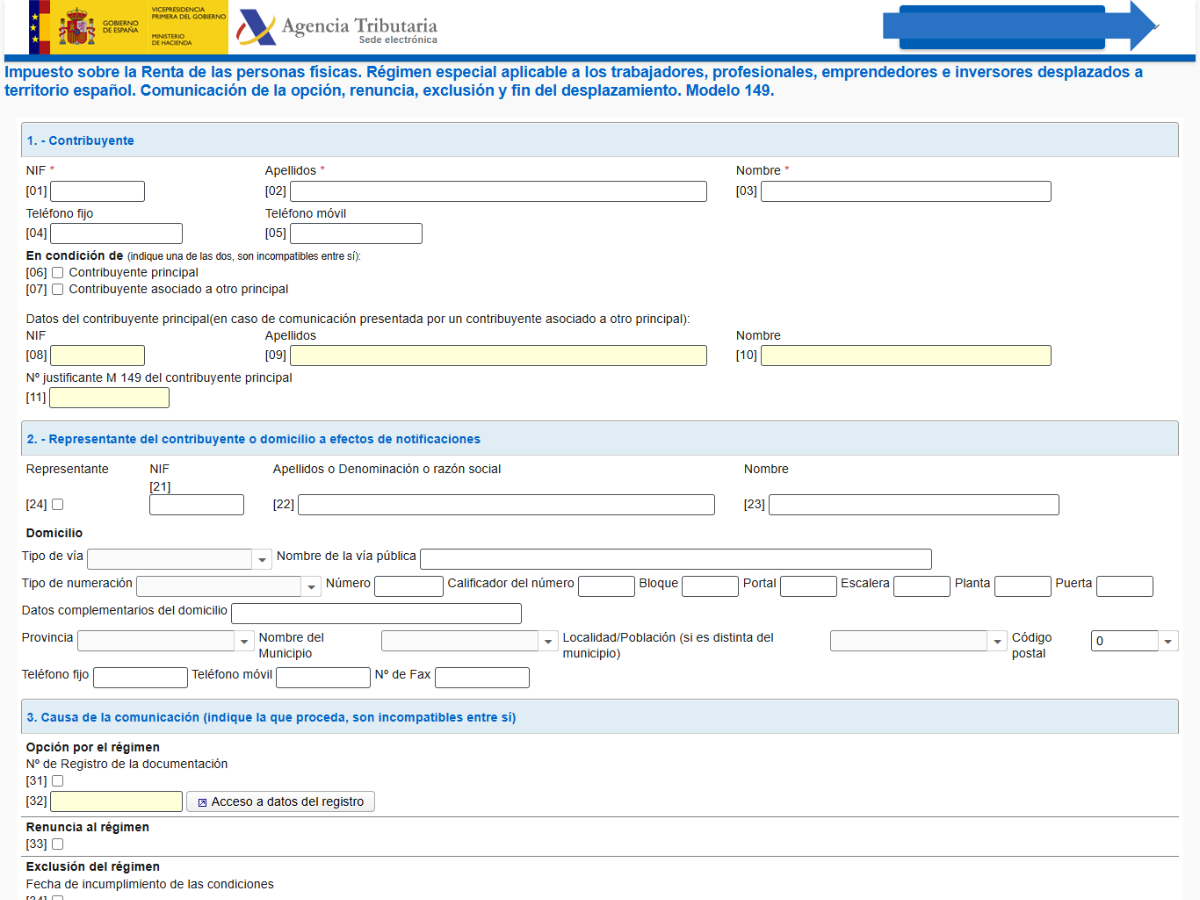
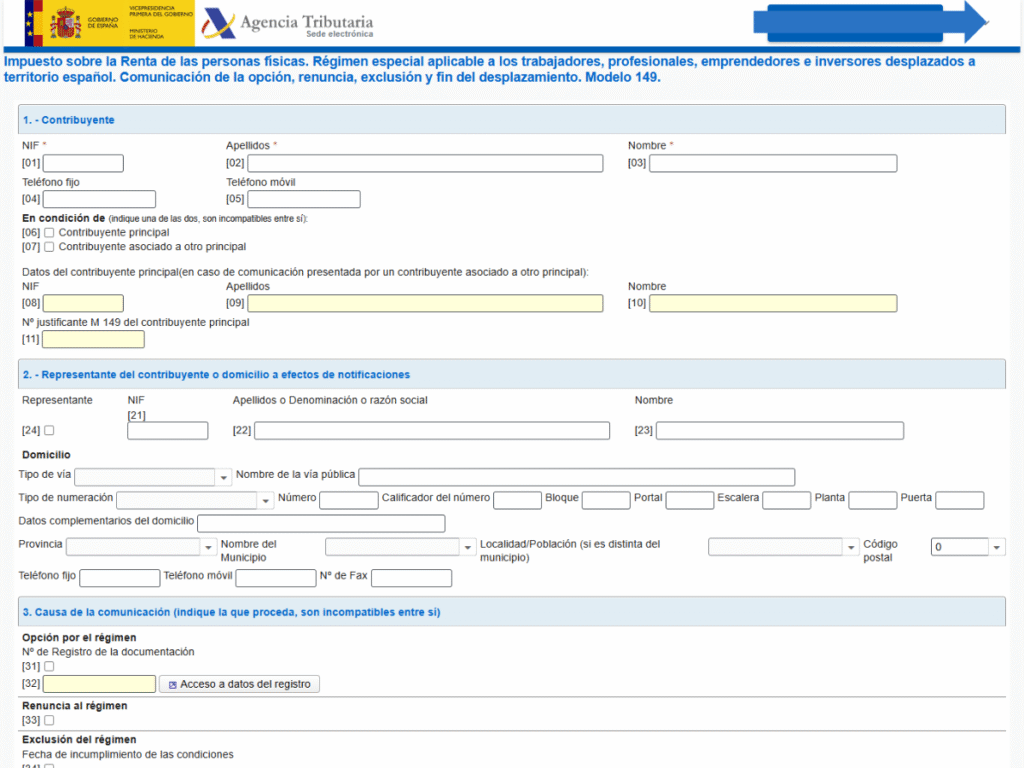
The entire process is managed electronically via the AEAT website (Agencia Tributaria). This is what you will see when filing Modelo 149.
Full Modelo 149 and Certificate of Election for the Special Tax Regime (Article 93 of the PIT Law)
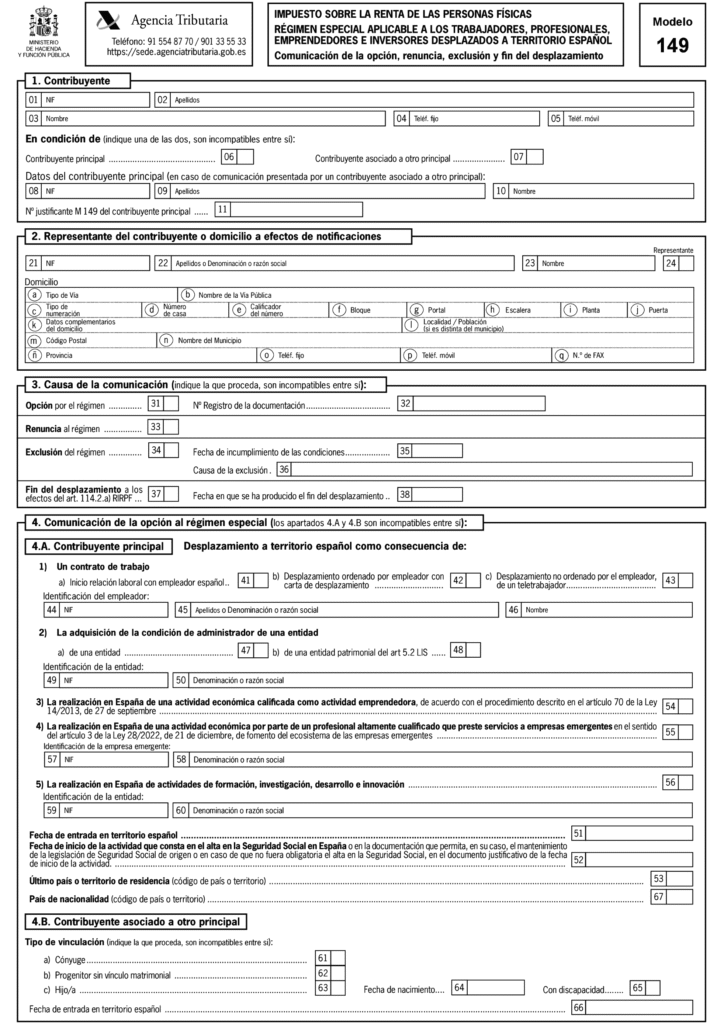
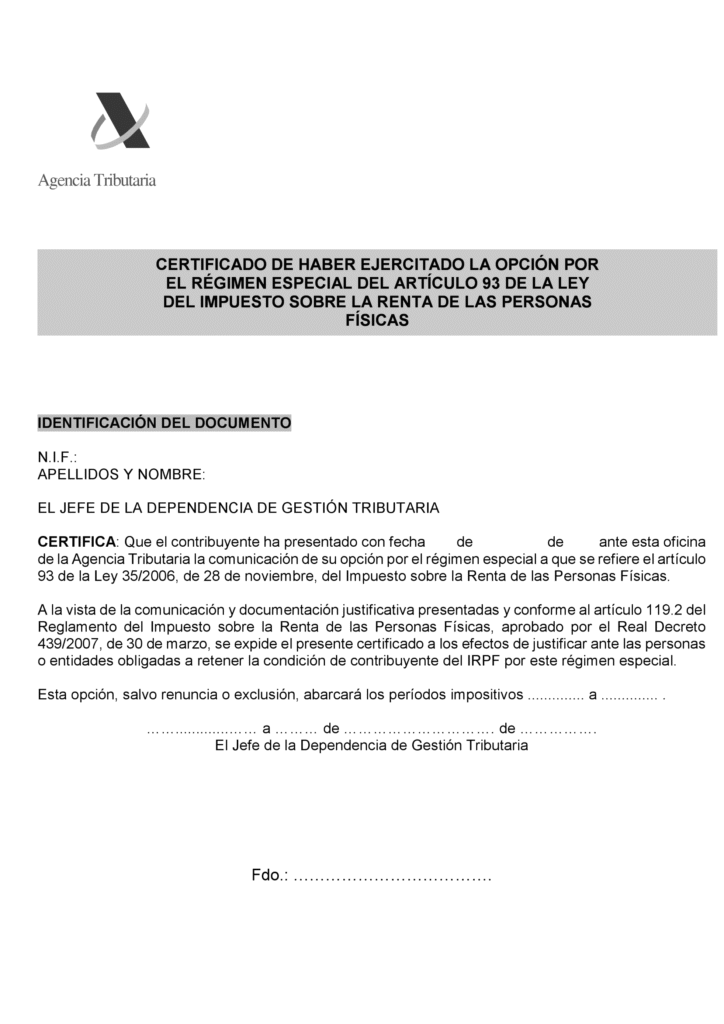
📄 Need an official form? > You can download the reference PDF and other tax models in our Spanish Tax Forms Library. We provide summaries and official BOE templates to help you prepare your filing.
🛠️ Step-by-Step Guide to Filing Modelo 149
The Two Crucial Steps
On the main page above, you will find these two specific links for the filing process:
| Step | AEAT Link Title (Spanish) | Purpose |
| Step A: Documentation | Aportar documentación necesaria para optar por el régimen especial | Crucial: Use this first to electronically upload your contract, passport, and other supporting documents. You must get a registration number from this submission. |
| Step B: Submission | Modelo 149. Presentación | Use this second to fill out and formally submit the Modelo 149 form itself, including the registration number from Step A. |
Step A: Gather Supporting Documentation
Unlike many Spanish forms, you must upload the supporting documents before or simultaneously with the form itself. These typically include:
- Your passport and NIE/TIE.
- Proof of the start of your activity (e.g., employment contract, social security registration, or transfer letter).
- A letter from your employer supporting the application (recommended).
You’ll upload these documents through the specific procedure on the AEAT website: “Aportar documentación necesaria para optar por el régimen especial”/ “Provide the necessary documentation to opt for the special regime”. Make a note of the registration number you receive for this submission.
You must upload these documents electronically using the link before submitting the Modelo 149 form itself.
General Identification & Residency
- Passport / Identity Document: A copy of your valid passport.
- NIE/TIE: A copy of your Foreigner Identity Number (NIE) or Identity Card (TIE).
- Proof of Spanish Tax Registration: Generally, this is confirmation of your registration in the Census of Taxpayers (often done via Modelo 030).
Proof of Relocation/Employment (The Justification)
This is the most important set of documents, which justifies your move to Spain under the special regime. You will need the document relevant to your specific situation:
| Situation | Required Document(s) |
| Standard Employment Contract | 1. Copy of the Employment Contract with the Spanish company or the letter of assignment/teleworking contract if working for a non-Spanish company (e.g., as a Digital Nomad). 2. Document proving your registration with the Spanish Social Security system (or equivalent document if you maintain non-Spanish social security, such as an A1 certificate). |
| Company Administrator (Director) | 1. Certificate of the corporate body appointing you as administrator/director. 2. Document proving your registration with the Spanish Social Security (usually under the Régimen Especial de Trabajadores Autónomos – RETA). |
| Entrepreneurial Activity | 1. Favorable report from ENISA (Empresa Nacional de Innovación) or another competent body that certifies the innovative nature of your project. 2. Document proving your registration with Social Security. |
| Highly Qualified Professional/R&D | 1. Contract or letter detailing the professional services you will provide to an emerging company, or your work in training, research, development, or innovation. 2. Document proving your registration with Social Security. |
Documentation for Family Members (If Applicable)
If you are applying for the regime for your spouse and/or children (they can also benefit under the new rules), you must include:
- Documentation (e.g., marriage certificate, birth certificate) proving the relationship.
- Documentation proving their residence in Spain.
- Any documents that prove they meet the income requirements (e.g., that their taxable income is less than yours).
🚨 Key Reminder: The Order is Critical
- Upload all supporting documentation using the “Aportar documentación…” link and save the registration number (CSV).
- File Modelo 149 and enter the registration number from step 1 into the form.
Step B: Complete and Submit Modelo 149
1: Secure Your Digital ID
To file online, you absolutely need one of the following:
- Digital Certificate (Certificado Digital): The most common method.
- Cl@ve PIN: A simpler identification system.
- Electronic DNI (DNIe).
2: Ensure Census Registration
Before submitting Modelo 149, you must be registered in the Census of Taxpayers, usually done via Modelo 030. If you have an NIE and are correctly registered as a resident, this step is typically complete.
3: Submit Modelo 149
- Navigate to the AEAT website and locate Modelo 149 (Personal Income Tax – Special Regime).
- Access the online form using your Digital ID.
- Fill out the required sections, including your personal data, and Crucially, the reference number from the documentation you submitted in Step 3.
- Validate the form for errors, then Sign and Send (Firmar y Enviar).
- Download and save the proof of submission (PDF) with the registration number. This is your receipt.
Since the Spanish Tax Agency (AEAT) website is organized by procedures, and filing Modelo 149 is a two-step process (uploading documents first, then submitting the form), I’ll provide the links to the main procedure page where you can initiate both steps.
🔗 Official AEAT Links for Modelo 149
You will need a Digital Certificate or Cl@ve PIN to access the online forms.
Main Procedure Page (Gestiones)
This page contains all the options related to the Beckham Law regime (Régimen especial aplicable a trabajadores, profesionales, emprendedores e inversores desplazados a territorio español):
- AEAT Procedure Page for Modelo 149
That is a critical point! The correct documentation is essential for the AEAT to approve your application.
The specific documents required depend on the category under which you are applying (e.g., employment contract, highly qualified professional, or company administrator).
⌛ What Happens Next?
The Tax Agency legally has 10 working days to issue a resolution. In practice, however, it can often take several weeks or even a month or two.
If approved, you will receive an official document confirming your acceptance into the special tax regime. You should provide a copy of this to your employer so they can correctly apply the non-resident withholding tax rate (currently a flat 24% on Spanish income up to €600,000).
⚠️ Important Note on Certifications
This document is specifically about the certification to enter the Beckham Law regime. If you need a general tax residence certificate for a double taxation agreement (DTA) with another country, you request a different certificate through the general “Certificates” section of the AEAT website.